Korean Age System Explained: How to Calculate Your Korean Age in 2026
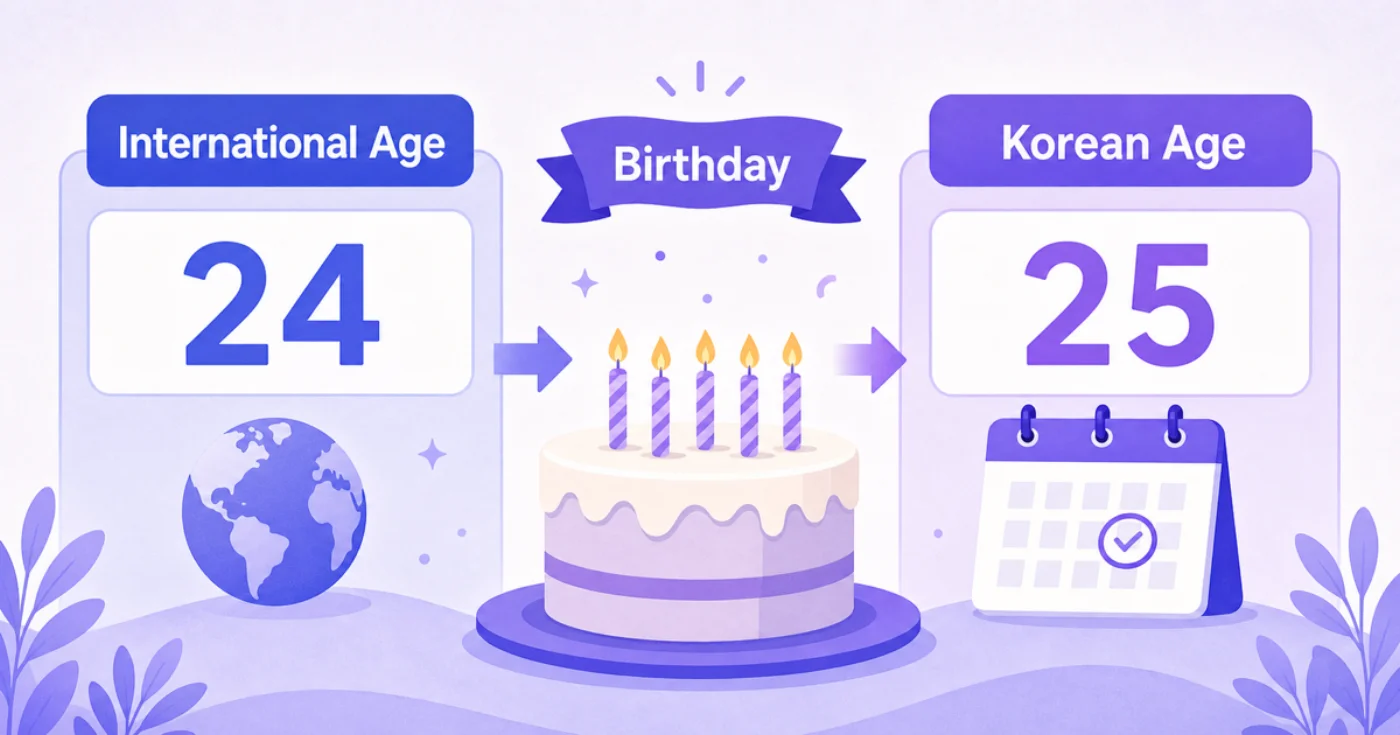
In Korea, asking someone their age is not small talk — it is a grammatical prerequisite. Before a Korean speaker can choose which verb ending, pronoun, or form of address to use, they need to know whether the person across from them is older, younger, or the same age. Until 2023, Koreans also lived under three competing age systems that could make the same person 20, 21, or 22 depending on which one you used. The 2023 reform cleaned most of that up, but the social rules tied to age have not changed, and learners still need to understand both the old system and the new to follow conversation, drama dialogue, and honorific choices.
The 3 Age Systems in Korea
Korea has historically used three different ways to count age, which is a source of endless confusion for foreigners and even Koreans themselves. Each system gives a different number for the same person on the same day.
1. International Age (만 나이 / Man Nai)
This is the system used worldwide. You are 0 at birth and gain one year on each birthday. This is now the official legal standard in Korea since June 2023. When Koreans say 만 나이, they mean this system.
2. Korean Age (세는 나이 / Seneun Nai)
The traditional Korean age system. You are 1 year old at birth, and everyone gains one year together on January 1st — not on their individual birthdays. This means a baby born on December 31st turns 2 years old the very next day, on January 1st. The formula is simple: Current year minus birth year plus 1.
3. Year Age (연 나이 / Yeon Nai)
A hybrid system sometimes used for legal purposes like military conscription and school enrollment. You start at 0 at birth but gain one year on January 1st rather than on your birthday. The formula is: Current year minus birth year. This system was used in some Korean laws before the 2023 reform.
| System | Korean Name | At Birth | Ages Up On | Example (born July 15, 2000) |
|---|---|---|---|---|
| International Age | 만 나이 | 0 | Birthday (Jul 15) | 25 (after Jul 15, 2025) / 26 (after Jul 15, 2026) |
| Korean Age | 세는 나이 | 1 | January 1st | 27 in 2026 |
| Year Age | 연 나이 | 0 | January 1st | 26 in 2026 |
How Korean Age Works
The Korean age system (세는 나이) is rooted in the idea that life begins at conception, not birth. Since a baby spends roughly nine months to a year in the womb, Koreans traditionally counted that time as the first year of life. Additionally, instead of tracking individual birthdays, the entire country ages together on the Lunar New Year — which in modern practice has shifted to January 1st of the solar calendar.
The formula is straightforward:
Korean Age = Current Year - Birth Year + 1. For example, if you were born in 1995 and the current year is 2026: 2026 - 1995 + 1 = 32. Your Korean age is 32, regardless of whether your birthday has passed this year.
This means that on any given day, your Korean age is either 1 or 2 years more than your international age. If your birthday has already passed this year, the difference is 1 year. If your birthday has not yet passed, the difference is 2 years.
The 2023 Law Change
On June 28, 2023, South Korea officially adopted international age (만 나이) as the standard for all legal and administrative purposes. The law unified age calculation across government documents, contracts, insurance, and public services. Before this change, different laws used different age systems, creating confusion — for example, you could legally buy alcohol at one age under one system but not another.
However — and this is the key point for language learners — Korean age did not disappear from daily life. Koreans still use 세는 나이 in everyday conversation, social situations, and when establishing relationships. When someone in Korea asks "How old are you?" casually, they almost always mean Korean age. The law changed official paperwork, but it did not change culture.
After the 2023 reform, Koreans often clarify which age they mean by asking "만으로요?" (by international age?) or specifying "만 나이로" (in international age) versus "한국 나이로" (in Korean age). If someone just says a number without clarification in casual conversation, assume Korean age.
There are a few areas where the old systems still have practical impact. School enrollment is based on birth year (all children born in the same year enter school together), and military conscription notices reference birth year. The drinking age is also commonly discussed in Korean age terms in daily life, even though the legal threshold now uses international age.
How to Calculate Your Korean Age
Calculating your Korean age takes just one step. Take the current year, subtract your birth year, and add 1. Your birthday does not matter — the result is the same whether you calculate on January 2nd or December 30th.
| Birth Year | International Age (in 2026) | Korean Age (in 2026) |
|---|---|---|
| 2006 | 19 or 20 | 21 |
| 2000 | 25 or 26 | 27 |
| 1995 | 30 or 31 | 32 |
| 1990 | 35 or 36 | 37 |
| 1985 | 40 or 41 | 42 |
| 1980 | 45 or 46 | 47 |
| 1970 | 55 or 56 | 57 |
The "or" in the international age column reflects whether your birthday has passed yet in 2026. Korean age has no such ambiguity — it is always a single number for the entire calendar year.
Why Age Matters So Much in Korean Culture
Age in Korea is not just a number — it is a social organizing principle. It determines the language you use, the titles you call people, who pours drinks first, and even who eats first at a meal. This is why one of the first questions Koreans ask when meeting someone new is their age. It is not considered rude; it is a practical necessity for choosing the correct speech level.
Titles Based on Age
Korean has specific titles for older people that depend on both the speaker's gender and the older person's gender. These are not optional — they are used constantly in daily life.
| Title | Pronunciation | Who Uses It | Meaning |
|---|---|---|---|
| 오빠 | oppa | Younger female → older male | Older brother / older male friend |
| 형 | hyeong | Younger male → older male | Older brother / older male friend |
| 언니 | eonni | Younger female → older female | Older sister / older female friend |
| 누나 | nuna | Younger male → older female | Older sister / older female friend |
These titles are used not only for biological siblings but for any close older person — friends, coworkers, seniors at school. Being even one year older in Korean age earns you one of these titles, and with it comes the expectation of respectful speech from the younger person.
Honorific Speech and Age
Korean has built-in speech levels (존댓말 and 반말) that are directly tied to age relationships. You must use polite or formal speech with anyone older unless they explicitly give you permission to speak casually. Two people who discover they are the same age (동갑) often immediately switch to casual speech and feel an instant bond. This is why establishing exact age — often down to birth month — matters so much.
Drinking Age and Social Norms
The legal drinking age in Korea is 19 in international age. In conversation, Koreans often still reference Korean age 20 as the threshold for adulthood and drinking. In social drinking situations, age hierarchy dictates etiquette: you turn your head away when drinking in front of an elder, and the youngest person at the table typically pours for everyone else.
The 빠른 (Ppareun) Concept — Early Borns
Korean school years are based on birth year, so all children born in the same calendar year enter the same grade. But what about people born in January or February? They are technically the same Korean age as the previous year's cohort. These people are called 빠른 (ppareun, meaning "fast" or "early") — for example, 빠른 95년생 means someone born in early 1995 who entered school with the 1994 cohort. They are socially considered the same "age group" as people born the year before, which creates interesting dynamics around titles and speech levels.
Age-Related Korean Vocabulary
Here are essential words and phrases for talking about age in Korean. You will encounter these constantly in daily conversation.
Common Confusion for Foreigners
In many Western cultures, asking someone's age is considered impolite, especially with adults. In Korea, it is the opposite — asking age is one of the first things people do when getting to know someone, and it is not considered rude at all. It is a practical social necessity.
Do not be surprised or offended when Koreans ask your age early in a conversation. They are not being nosy — they need this information to choose the right speech level and titles. You can simply answer with your birth year: "95년생이에요" (95-nyeonsaengieyo, "I was born in 95"). Koreans often share birth years instead of exact ages because the year is what determines your social age group.
Another common point of confusion is when a Korean person tells you their age and it does not match what you expected. Always clarify which system they mean. If you are filling out official forms in Korea, use 만 나이 (international age). If you are chatting with friends or trying to figure out social dynamics, Korean age is likely what everyone is using.
Quick Summary
The Korean age system is one of those cultural concepts that seems confusing at first but becomes second nature once you understand the logic. Remember: Korean age equals the current year minus your birth year plus one. The 2023 law made international age the legal standard, but Korean age lives on in everyday conversation. And most importantly, age in Korea is not just small talk — it shapes the entire way people interact, from the words they choose to the way they pour a drink.
Practice age-related conversations with HangeulMate's dialogue scenarios. The "Meeting New People" and "Making Friends" dialogues include natural age-asking situations where you can learn the right phrases and speech levels in context.
Start Learning Korean Today
Master Hangul in 7 days with interactive lessons, AI conversation practice, and spaced repetition. 100% free to start.
Get Started FreeRelated Articles
Korean vs Japanese vs Chinese: Key Differences for Language Learners
Compare Korean, Japanese, and Chinese writing systems, grammar, and pronunciation. Discover why Korean is often considered the easiest to start.
Korean Honorifics Explained: Formal, Polite, and Casual Speech
Understand the Korean honorific system: formal (합쇼체), polite (해요체), and casual (해체) speech levels. Learn when to use each with real examples.
10 Common Mistakes English Speakers Make When Learning Korean
Avoid these 10 common mistakes English speakers make when learning Korean. From pronunciation pitfalls to grammar mix-ups, learn how to fix them.